
The Push Dagger
A Compact Legacy of Self-Defense
The push dagger traces its roots back to the 19th century, emerging as a close-quarters weapon favored by gamblers, sailors, and soldiers for its concealability and ease of use.
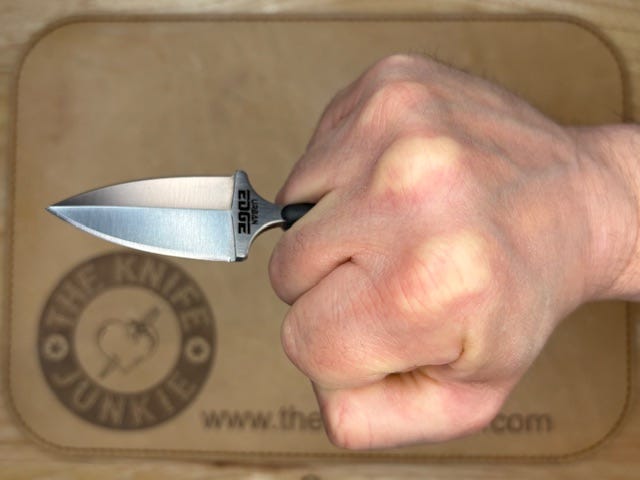
Characterized by a short blade perpendicular to a T-shaped handle, the design allows for a powerful punching grip, maximizing force in tight spaces. Historically seen in forms like the Indian Katar and later Western iterations such as World War I trench-knife variants, push daggers were valued for their simplicity and effectiveness when firearms failed, or stealth was paramount.
Over time, they evolved from battlefield tools into symbols of personal defense, often associated with undercover operatives and civilians seeking discreet protection.
Today, modern knife makers have refined the push-dagger concept using advanced materials and ergonomic designs. Cold Steel’s Urban Edge exemplifies this evolution—compact, rugged, and built from durable AUS-8A stainless steel with a secure Grivory handle.
Other notable versions include TOPS Knives’ compact push daggers, such as the iStick and Grim Ripper, which emphasize tactical utility and full-tang construction, and Microtech’s sleek Push Daggers in a Bastinelli collaboration.
Brands like Boker, Kubey, and Civivi also offer budget-friendly yet reliable models, catering to a broad range of users.
These contemporary versions maintain the core philosophy of the push dagger—rapid deployment and potent impact—while enhancing safety, comfort, and legal compliance in various jurisdictions.
For me, integrating a push dagger into my everyday carry has been both practical and reassuring, thanks to the Cold Steel Urban Edge.
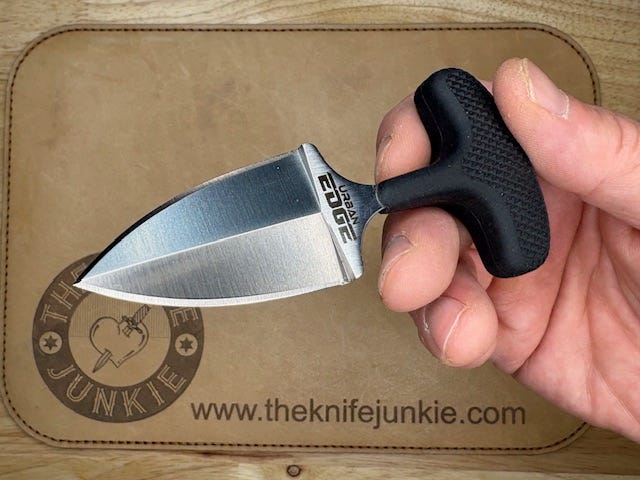
Its slim profile and included belt sheath allow it to ride comfortably on my belt, virtually undetectable beneath a shirt and often forgotten during daily routines—until peace of mind is needed.
The secure grip ensures confidence in high-stress scenarios, while its non-threatening appearance avoids undue attention. Whether running errands or traveling through unfamiliar areas, the Urban Edge serves as a silent guardian, embodying the push dagger’s enduring legacy in a modern, discreet form.
It’s not about aggression, but preparedness—and this small blade delivers both with quiet reliability.
Knife Junkie Out

Patrons of The Knife Junkie receive regular Knife Notes, including “Maker Monday” and the “Friday Funnies,” as part of their support. To receive regular knife-related articles that include images and graphics, join The Knife Junkie Patreon group at any paid level. All paying members of the TKJ Patreon group will receive these informational items, along with early access to the podcasts, exclusive bonus content from podcast guests, stickers, a Knife Junkie coaster—and, of course, our gratitude for your support.

Three Jobs a Tomahawk Did Better Than a Musket
In the dense timber of the 18th-century American frontier, a musket was your primary insurance policy. But it gave you exactly one shot before it turned into an awkward, nine-pound club.
If you were a militiaman, a long hunter, or a Native warrior in 1776, your actual lifeline was the forged iron hawk tucked into your belt. As we count down to July 4, 2026, marking 250 years of American grit, it’s worth looking at why the tomahawk was the ultimate multi-tool of the revolution.
Here are three things a tomahawk did vastly better than the guns of the era:
1. Kept You Alive in the Brush. Reloading a flintlock takes fifteen seconds of standing still. In a close-quarters woodland ambush, you don’t have fifteen seconds. The hawk was instantly accessible, devastatingly fast, and never ran out of powder. It hooked, parried, and crushed with brutal efficiency.
2. Built the Camp. A knife can dress a deer, but it struggles to build a shelter. A proper colonial tomahawk featured a razor-sharp, forge-welded high-carbon steel bit. It could drop saplings for a lean-to, split pelvic bones on an elk, process firewood, and strike sparks off a flint rock to start a fire. It was the wilderness survival kit of the 1700s.
3. Sealed the Deal. The pipe tomahawk did something no other weapon could do: it acted as a diplomat. Blacksmiths drilled a smoke channel straight through the curly maple handle, connecting it to a tobacco bowl forged into the poll of the axe head. You could fight your enemy in the morning, and smoke tobacco with them out of the exact same tool in the afternoon. It was commerce, war, and peace in one piece of iron.
Look closely at an original pipe hawk’s head. You’ll see a faint, jagged line where the hard steel cutting edge meets the softer iron body. That’s a forge weld—a permanent scar left by a blacksmith swinging a hammer by the light of a coal fire.
Want to know how that 18th-century forge scar directly influenced the modern tactical tomahawks used by breachers today? We break down the metallurgy, history, and modern combat of the hawk over on our American Edge 250 Patreon series.

Start your online e-commerce store with LaunchCart—the easiest and simplest platform to build a high-converting online store to sell anything you want. LaunchCart includes features that competitors charge extra monthly fees for. Start your free trial today.
A Bevy of Beauties Beyond Belief - Prototypes Knives by Dirk Pinkerton

